

The Tool of Labour as an Extension of the Human Hand
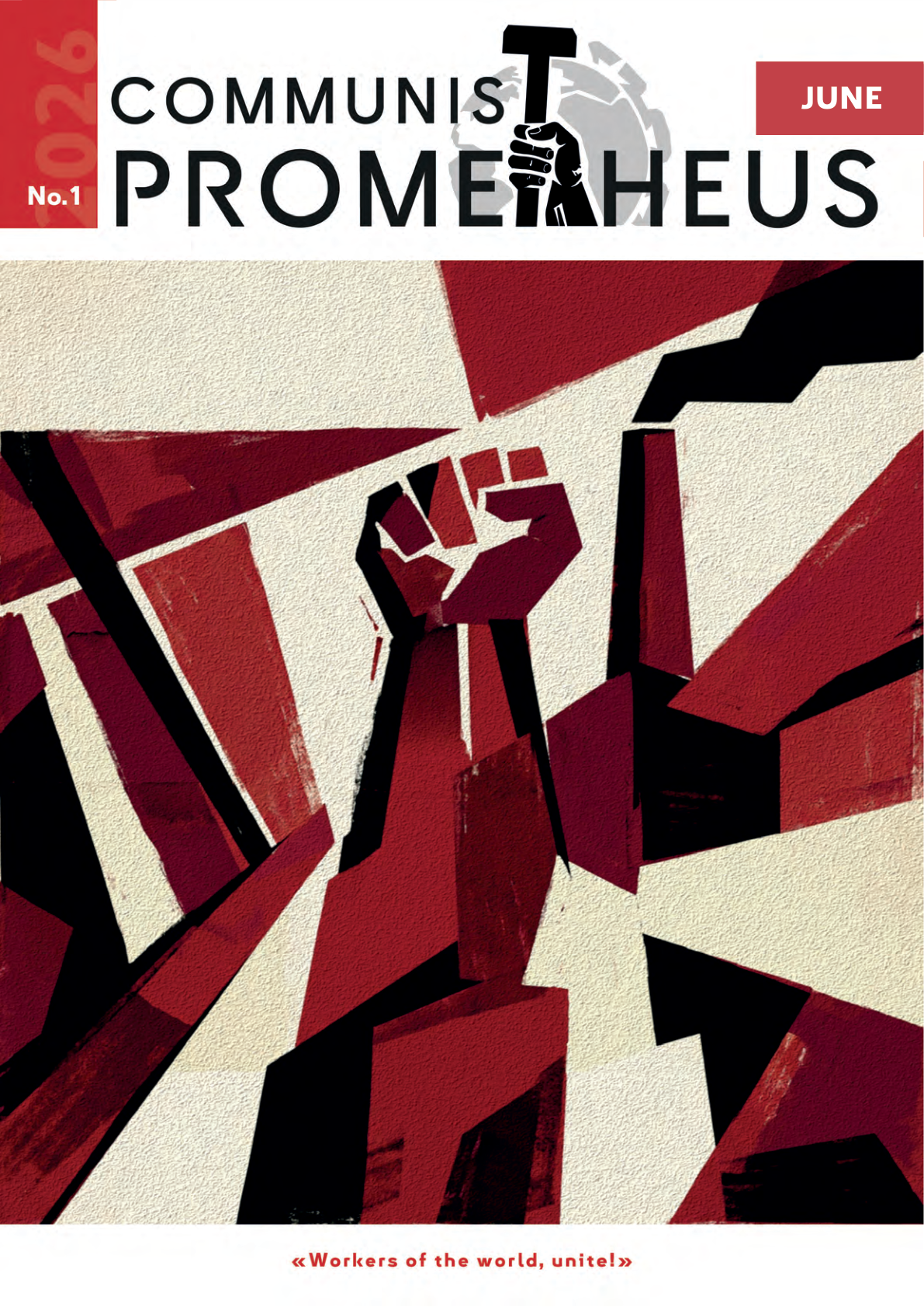
We wish to openly acknowledge our conscious use of artificial intelligence (AI) to generate illustrations for our magazine. We are not professional artists. We arrived at this decision on the basis of the Marxist conception that the tool of labour is an extension of the human hand.
Just as a builder consciously directs the hand with which he firmly grips a trowel while constructing a wall, we directed AI to achieve the aesthetic and conceptual results we required. In “Capital”, Karl Marx offers a famous analogy: the worst architect differs from the best of bees in that the architect has already built the cell in his mind before constructing it in wax. In this case, the role of the architect belongs to us, while AI assumes the role of the digital bee.
Our approach is grounded in the understanding that the machine itself is devoid of purpose. As the philosophers Evald Ilyenkov, Arseny Arsenyev, and Vasily Davydov wrote in their article “Machine and Man, Cybernetics and Philosophy”1: «It is not the brain that thinks, but the human being with the aid of the brain»2. Similarly, Ilyenkov explains in “The Problem of the Ideal”: «It is not the hand that works, but the human being with the aid of the hand. And the product of his labour is located not “in the hand”, not inside it, but in that substance of nature which is thereby processed»3. In this instance, AI served merely as our digital trowel – an obedient organ set in motion by human intention.
Karl Marx developed this dialectical connection between the brain, the hand, and the tool of labour – in which technology serves merely as an extension of the human being – most fully in the Grundrisse (Economic Manuscripts of 1857–1859). Marx writes:
«Nature builds no machines, no locomotives, railways, electric telegraphs, self-acting mules etc. These are products of human industry; natural material transformed into organs of the human will over nature, or of human participation in nature. They are organs of the human brain, created by the human hand; the power of knowledge, objectified. The development of fixed capital indicates to what degree general social knowledge has become a direct force of production, and to what degree, hence, the conditions of the process of social life itself have come under the control of the general intellect and been transformed in accordance with it. To what degree the powers of social production have been produced, not only in the form of knowledge, but also as immediate organs of social practice, of the real life process».4
«As long as the machine remains a machine», as Ilyenkov, Arsenyev, and Davydov emphasise, «it remains only an artificially created organ of the socially human rational will, a means of its active manifestation. And in this sense – an organ of the human brain, for by “brain” Marx always meant not merely, and not even primarily, the bodily organ of the individual, but rather the organ of the socially human rational will, of socially human needs, and of the “goals” that ideally express those needs».5
It was precisely this rational will that we exercised when composing textual descriptions (prompts) for the neural network. We described in detail what we wished to depict and strictly defined the stylistic framework, directing the machine towards specific historical forms of revolutionary proletarian culture – the styles employed by revolutionary artists in Russia and Hungary between 1917 and 1921.
We engaged with a visual language intended to construct a new world. This involved strict geometricization of forms, the use of powerful diagonals to convey the dynamics of struggle, the dominance of a contrasting palette (red, black, white), typographic compositions, and photomontage. We oriented the machine toward the works of authors such as El Lissitzky (whose legendary 1919 poster “Beat the Whites with the Red Wedge” became the supreme expression of Suprematism in the service of revolution), Vladimir Tatlin (with his tower striving toward the future-the Monument to the Third Communist International), Alexander Rodchenko, and Kazimir Malevich.
We demanded that the machine reproduce the expressive monumentality characteristic of the Hungarian group of revolutionary artists, poets, and writers “MA” (“Today”). This art combined Cubo-Futurist dynamics with proletarian pathos, creating heavy, chiselled, monumental figures of workers and soldiers, full of tension. Our references included the works of Lajos Kassák, creator of the “picture-architecture” concept; Béla Uitz, author of the famous fervent 1919 poster “Red Soldiers, Forward!” (Vörös katonák, előre!); and Sándor Bortnyik, author of Futurist expressionist works on revolutionary themes, such as “The Red Locomotive” and “Red May”.
Artificial intelligence is incapable of grasping the essence of these historical events, for the realm of spiritual culture in which genuine imagination arises remains closed to it. As Ilyenkov, Arsenyev, and Davydov noted, «without imagination, there can be no question of truly creative thinking»6. AI merely blindly combined pixels according to calculated probabilities.
The form ultimately taken by these images is the objectified form of the dialectical transformation of an ideal, spiritual perception of the world into a material product of human labour, achieved through the use of an extended hand – that is, a form of human life-activity. Thus, the illustrations in our magazine are not the product of machine “creativity.” They are the product of our conscious activity, our knowledge of the history of revolutionary art, and our aesthetic choices, realised through a modern, complex, yet entirely human-subordinated cybernetic tool.
The Dialectics of the Digital Trowel: Expropriating the Expropriators in the Age of AI
In our endeavour to use artificial intelligence to construct a new visual language, we inevitably confront a profound dialectical contradiction. On the one hand, we regard AI as a cybernetic trowel, an obedient organ of human will. On the other – we recognise the harsh political-economic reality: this trowel is today monopolised by capital; it has become “dead labour”, trained through the expropriation of colossal masses of social knowledge.
Does this mean that the use of generative networks makes us accomplices in capitalist exploitation and conscious appendages of corporate algorithms? Historical materialism teaches us not to flee from contradictions, but to resolve them through material practice. The key to such a resolution lies in the fundamental difference between our approach and the logic of capital.
As Marx wrote, the defining characteristic of capital is its drive towards self-expansion through the production of commodities (the formula M – C – M’). Corporations developed AI in order to generate profit.
We, however, do not use AI to produce a commodity. We do not bring our product – the magazine and all its contents, including the images generated by neural networks – to the market, nor do we make it an object of market exchange. Our product contains no exchange-value; it is created exclusively for its use-value – it serves as our collective organiser, propagandist, and agitator.
By refusing to sell a product that incorporates elements created with the aid of neural networks, we create no surplus value and extract no profit. If capital, like a vampire, sucks up living labour in order to transform it into profit, then we use the computing power owned by big capital to create a non-commercial, revolutionary magazine, thereby effectively compelling the machine to work in the interests of all humanity.
The creators of generative neural networks have carried out the greatest enclosure of the twenty-first century: they have expropriated the “general intellect”, sucking up, like vampires, the unpaid living labour of millions of people and transforming it into capital in order subsequently to sell access to it. They abolished copyright at the stage of data collection, yet rigorously enforce it at the stage of selling their services.
How can we overcome this? Only through reverse expropriation – that is, through the abolition of private property.
For now, by wielding this tool, we extract the synthesised experience of generations – including the legacy of the revolutionary avant-garde – from the corporate “black box” and return it to the arsenal of class struggle. What was appropriated by capital, stolen from the working masses in order to create a monopoly, we restore to the proletarian avant-garde as an intellectual weapon for liberation from the rule of capital. We strike capitalism with its own weapon, brought to perfection.
Marxism examines the problem of alienation primarily through the question of who owns labour and for what purpose it is performed. Under capitalism, the worker is alienated from both the process and the product of labour because they work in order to survive, creating wealth that is appropriated by the bourgeoisie.
In our case, the process of constructing prompts is not alienated wage labour. It is free and conscious political activity. Yes, the physical act of drawing is delegated to the machine, but purpose, historical reflection, and ideological control remain entirely in human hands. In this context, AI acts not as a replacement for the artist, but as a high-tech printing press, amplifying the voice of the proletarian avant-garde many times over. We are fully aware that even by training AI with our prompts, we inevitably generate new data, temporarily paying tribute to capital. Yet we regard this as a forced tactical concession – the use of the enemy’s infrastructure in order to wage a strategic offensive against it.
Marx and Engels repeatedly emphasised that capitalism, in its blind pursuit of profit, itself creates the material and technical basis for communist society. By building giant factories, railways, and today – data centres and global neural networks – capital socialises production on an unprecedented scale, although the appropriation of its results remains private.
In the Economic Manuscripts already cited, Marx draws another crucial conclusion: capital develops machinery in order to reduce necessary labour time. Under capitalism, this leads to unemployment. Under communism, automation will create free time for the free intellectual and creative development of every individual.
Generative AI is the highest form to date of the socialisation of spiritual production. It lays bare the central paradox of capitalism: a technology capable of radically reducing labour time and granting humanity the space for free creative development is used solely to maximise corporate profits. It bears the birthmarks of capitalism: theft, monopolisation, and exploitation. But historical materialism does not require us to wait for the emergence of flawless, ideologically pure tools. Revolution is always made from the human and technological material created by the old era.
By using AI not for the extraction of profit, but for communist propaganda, we demonstrate what the powerful productive forces created by capitalism are capable of when freed from the fetters of commodity-money relations and subjected to conscious social will.
May 2026
Footnotes
-
- We refer to this article solely because it represents one of the earliest and most successfully formulated complete statements of the of the “thinking machine” from correct Marxist positions. Within the scope of this article, there is no need to dwell on each of the authors of “Machine and Man, Cybernetics and Philosophy”. Nor do we consider it necessary here to undertake a detailed examination of the figure of Evald V. Ilyenkov (1924–1979), the best known among them and, in all likelihood, the one who made the principal theoretical contribution to the work we cite. Nevertheless, we cannot refrain from offering a brief assessment of this highly controversial and contradictory figure. For contemporary Marxists, his works retain a certain value in the fields of methodology (the defence of dialectics against positivism and the analysis of the logic of “Capital”) and the history of philosophy. However, in his writings he repeatedly revised Marxism in a Hegelian direction (particularly in his specific interpretation of the ideal and other important philosophical questions) and also demonstrated an erroneous understanding of certain key categories of political economy. The same idealist limitation manifested itself in his political views. Fully sharing the Stalinist dogma that socialism existed in the USSR – that is, denying the capitalist character of that state’s economy – Ilyenkov reduced the question exclusively to the philosophical problem of alienation and the cultural underdevelopment of the masses (the contradiction between formal and real socialisation), thereby evading a class analysis of “Soviet” society. This prevents us from calling him a genuine Marxist, for one cannot become such without engaging in revolutionary practice, without participating in the class struggle of the proletariat against the bourgeoisie, above all against “its own” bourgeoisie. He did not struggle against this bourgeois state but supported it, albeit while occasionally criticising it, and always remained a model “chair socialist”, advocating its reform, improvement, and humanisation. Thus, he was an accomplice of our class enemy (and not merely on the theoretical front). Were it not for this final and extremely important consideration, this note would be unnecessary. ↩
-
- Ilyenkov E., Arsenyev A., Davydov V. Machine and Man, Cybernetics and Philosophy // Lenin’s Theory of Reflection and Modern Science. Moscow: Nauka, 1966. P. 263. ↩
-
- Ilyenkov E. The Problem of the Ideal // Voprosy Filosofii. 1979. No. 6. P. 135. ↩
-
- K. Marx. Grundrisse: Notebook VII – The Chapter on Capital // Marxists Internet Archive. URL: https://www.marxists.org/archive/marx/works/1857/grundrisse/ch14.htm ↩
-
- Ilyenkov E., Arsenyev A., Davydov V. Op. cit. P. 276. ↩
-
- Ibid. P. 269. ↩